This article focuses on subcutaneous Wegovy injection in adults. A paper about semaglutide and digestive symptoms can invite a personal question: does this describe what would happen to me? Before interpreting an average, there is another question to settle: whose observations produced it? Entering research, receiving treatment, remaining in follow-up and contributing to an analysis are related experiences, but they are not interchangeable. Understanding the connection between them helps explain both what a finding means and why its relevance can change when the question changes.
The aim here is to follow those connections. Recruitment sets an initial boundary; later experience and analysis choices can set others. An informative result need not describe every person who might consider treatment. Its usefulness depends on stating its question clearly enough that readers can judge the fit. Looking closely at participation is therefore part of interpreting the science, not an administrative detail to skip on the way to the outcome.
The population changes as the study progresses
The GI analysis revisited STEP 1–3 after the trials. STEP 2 included type 2 diabetes; STEP 1 and 3 did not. Its week-68 weight comparison required a measurement and recent treatment. Symptoms were observed, not assigned. Novo Nordisk funded the trials and writing; sponsor employees were authors. [1]
The central interpretive task is to connect a result to the observations supporting it. Eligibility describes who could enter; assignment describes the comparison investigators created. Later measurements describe whose experience is available for a particular analysis. These are different scientific roles. A statement can accurately describe an observed group while leaving the experience of people outside that group unresolved.
Read those roles as a sequence of questions. Was the person eligible for the underlying research? Did the person contribute the kind of observation needed for the later comparison? Does the conclusion concern the original assignment, subsequent experience, or both? Answering the last question requires more than recognizing the drug name. Otherwise, a reader may silently replace the population actually analyzed with everyone who might receive a prescription.
A broader collection of trials can offer more perspectives without eliminating the need to identify each perspective. The useful unit of interpretation is therefore a defined comparison under defined conditions. Before accepting a general claim about digestive symptoms, ask what observation would count as support for it and whose observation could enter. That question makes the limits visible without dismissing the research as uninformative.
Eligibility defines the reach of an observation
An inclusion rule and a finding about differences between people are logically separate. The presence of a health condition in a study tells us that relevant experience may be represented. It does not, by itself, show whether that condition changes a treatment association. Establishing such a difference would require an appropriate comparison, enough information to estimate it, and uncertainty considered alongside the estimate.
Conversely, excluding a group creates an evidence gap rather than an automatic negative finding about that group. The missing comparison could eventually support similarity, difference, or substantial uncertainty. Choosing one of those answers before observing the comparison would replace evidence with an assumption. This matters when a study title sounds broad: a broad topic cannot remove an eligibility boundary that was part of generating the observations.
A useful reading habit is to separate representation from precision. A group can be present without its specific result being estimated clearly enough for a confident conclusion. Combining information may make an overall estimate easier to describe while leaving that narrower question open. When exploring another topic in the peptide guide, carry forward the same distinction: identifying a research population is the beginning of judging applicability, not the end of it.
Treatment is delivered inside a study setting
STEP 3 paired both randomized treatments with intensive behavioral support. Participants did not have diabetes. Novo Nordisk funded the trial. [2]
This setting matters because a randomized contrast answers a question about the alternatives actually offered. A shared element of care can remain in the background of both alternatives while still shaping the setting in which outcomes are observed. Removing that element in a later interpretation creates a different question. The original contrast cannot automatically provide the answer simply because the medication name stays the same.
There are two tempting but unsupported leaps here. One is to assume that background support explains the result. The other is to assume it is irrelevant because both groups received it. The first needs a comparison that separates its contribution; the second needs evidence that changing the setting would leave the relevant result unchanged. Recognizing both possibilities preserves the value of the assigned-treatment comparison without extending it beyond its conditions.
This also separates clinical research from choosing a service. A provider decision involves documentation about the service being considered, not only evidence about a treatment studied elsewhere. If that is your next question, use the Ro review to examine dated provider documentation separately. A trial result cannot establish the outcomes of a particular provider, and a familiar treatment name does not make those two evaluations interchangeable.
Following someone and treating someone are different
ICH guidance distinguishes stopping treatment, leaving follow-up and missing measurements. The question a trial answers depends partly on how it handles events after treatment begins. [4]
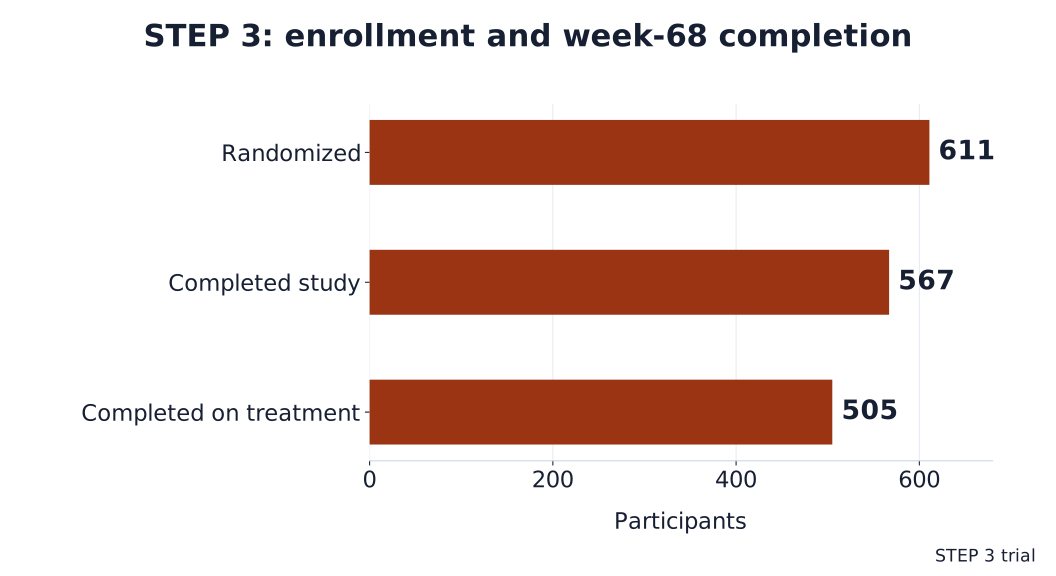
The chart below helps distinguish the kinds of participation that a simple completion statement can conceal. Read each bar according to its label rather than treating every bar as a treatment outcome. A difference in how many people meet different completion descriptions is informative about the observations available. It is not, by itself, an explanation of what happened to anyone who falls outside a description.
Consider the underlying logic without assigning a story to the participants. Continuing to observe someone after treatment ends could help answer a question about later experience. Continuing treatment could help answer a question tied to ongoing exposure. A measurement can be useful for one purpose without satisfying the definition of another. That is why follow-up and treatment should remain separate concepts even when a study reports them close together.
The figure should therefore prompt questions about evidence coverage, not a calculation of medication benefit. Its categories are not separate groups to add together, and the distances between bars cannot reveal a cause of departure. A causal explanation would need information linking the relevant events, their timing and the comparison of interest. Keeping the chart descriptive avoids turning an accounting of participation into a claim about why treatment succeeds or fails.
STEP 3: enrollment and week-68 completion
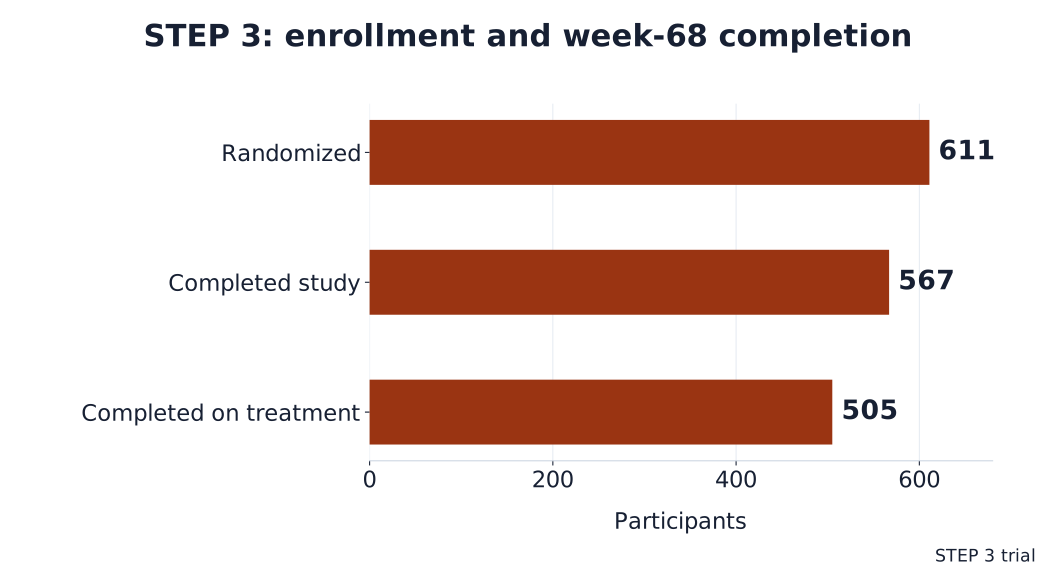
On a narrow screen, scroll the chart and data table horizontally. You can also download both files.
Download chart (SVG)Download chart data (CSV)
| Stage | Participants |
|---|---|
| Randomized | 611 |
| Completed study | 567 |
| Completed on treatment | 505 |
The weight analysis is a narrower window
An observed endpoint comparison has a doorway: an observation must satisfy the analysis definition to pass through it. That doorway is part of the meaning of the result. If the scientific question concerns experience under a particular exposure condition, restricting observations can be purposeful. But changing the question to the experience of everyone who starts treatment does not make the same selected observations complete evidence for that broader purpose.
Two uncertainties deserve separate attention. One concerns whether the outcome is available. The other concerns whether an available outcome belongs in the chosen comparison. Treating both as simply lost data obscures the difference between an absent measurement and an analysis decision. It can also encourage an unjustified assumption that everyone outside an analysis was unreachable, uninterested in follow-up, or affected in the same way. None of those explanations follows from exclusion alone.
Selection becomes especially relevant when the reason an observation is included could relate to the outcome being studied. In principle, that relationship might make the observed experience differ from the experience left outside. The direction is not determined by the word selection: it requires evidence. A careful interpretation therefore states the population to which the comparison directly applies, then keeps the broader question open. Precision within the observed comparison and uncertainty about its wider reach can coexist.
A symptom group is formed after assignment
Random assignment creates a comparison around the intervention assigned. Grouping people later by something they experience creates a different comparison. The second grouping does not inherit every protection of the first merely because both appear in the same research program. To interpret a symptom association, distinguish the decision made by the study design from the events that unfolded afterward. Otherwise, a descriptive contrast can be mistaken for an experiment on symptoms themselves.
Several explanations could, in principle, connect a recorded symptom with a later outcome. There might be a causal pathway, a shared influence on both, or a difference in the opportunity to observe them. These are competing possibilities, not findings established by naming them. An observed association does not choose among them automatically. Nor would statistical adjustment guarantee that every relevant difference had been measured correctly or handled adequately; that requires evaluating the assumptions of the particular analysis.
This distinction changes the practical meaning of the question. Asking whether a symptom marks a pattern in observed data differs from asking what would happen if that symptom were deliberately prevented or produced. The latter needs evidence about an intervention, not just a grouping. The companion discussion of tirzepatide symptom comparisons provides another opportunity to apply that distinction. Reading across treatments should sharpen the question being asked, not turn separate studies into a comparative ranking.
Maintenance trials start their comparison later
STEP 4 randomized eligible participants after a 20-week semaglutide run-in, then followed the randomized comparison for 48 weeks. Novo Nordisk funded the trial. [3]
Moving the moment of randomization later changes the starting point of the randomized question. Experience accumulated before that moment becomes part of the context in which the comparison begins. A reader interested in a first treatment decision is asking about an earlier point in the sequence. Evidence generated after a selection stage may remain valuable, but its relationship to that earlier decision needs an explicit argument rather than an assumed equivalence.
This does not mean selection before randomization cancels randomization afterward. Those are different issues. Assignment can support a credible comparison within the population reaching that stage while leaving uncertainty about people who never reached it. The right response is to preserve both statements: the comparison has its own internal meaning, and the population to which it directly applies has boundaries. Rejecting the study entirely would lose useful information; erasing the boundary would overstate it.
The same logic prevents treating participation at a later stage as a permanent personal characteristic. Being represented at that point does not answer every question about earlier experience or future outcomes. A maintenance question concerns what happens from its chosen starting conditions. A first-prescription question concerns the path toward those conditions as well. Keeping the two questions distinct makes it easier to see what additional evidence would connect them.
An average does not identify the person in front of it
An average association and a useful individual prediction serve different purposes. The average summarizes a comparison. A prediction must tell us something sufficiently reliable about an individual outcome, using information available when the prediction is needed. Moving from one to the other requires more than finding a participant who resembles the person asking the question. Resemblance is relevant to applicability, but it is not a measure of predictive accuracy.
For a prediction claim, ask what is being predicted, when it would be known and how its accuracy would be checked in people beyond those used to construct it. A symptom pattern might be discussed after outcomes occur; a decision aid needs to work at the time of the decision. Confusing those times can make an explanation of past observations sound like a forecast that has already been tested. A forecast that sounds plausible is not enough; it must remain useful when compared with outcomes that were unknown when the forecast was made.
This is also a useful boundary when reading a semaglutide and tirzepatide comparison. A comparison can organize different questions without resolving every individual choice. The relevant task here is to identify how closely the population, setting and observation conditions align with the question being asked. Where they differ, describe the uncertainty rather than assuming that a shared diagnosis or a similar average supplies a personalized answer.
What would make the evidence more transferable?
The most useful next study would address a specific unresolved comparison. If the question concerns experience after treatment ends, observations extending beyond that event would matter. If it concerns a different care setting, that setting needs to enter the evidence. If it concerns people outside an eligibility boundary, their experience cannot be supplied merely by describing the existing participants in greater detail. Each gap calls for information matched to the question.
More data are helpful only if they improve that match. An additional average from the same selected observations might make a familiar summary more precise without answering why other observations are absent. Useful reporting would connect the timing of treatment, symptoms, measurement and follow-up, while distinguishing what was observed from what an analysis assumed. That would let readers examine alternative explanations instead of treating a single completion label as a complete account.
Funding information should guide scrutiny of those choices without substituting for it. The relevant evaluation asks whether the comparison is clearly defined, the analysis can be understood, and the conclusion stays within what the observations support. Financial involvement alone cannot quantify an error or identify its direction. Equally, disclosure does not remove the need to inspect the methods. The strongest interpretation follows the evidence through those choices rather than treating sponsorship as either a verdict or a reassurance.
Use the current label for a current safety question
Wegovy can cause severe gastrointestinal reactions and is not recommended with severe gastroparesis. Severe or persistent symptoms need clinical assessment; trial averages are not a reason to wait. [5]
A research interpretation and an assessment of a current symptom answer different questions. The former concerns what can be learned from a defined comparison; the latter requires attention to the person and the present situation. The semaglutide entry is a separate place to review product context. This article does not translate study averages into a decision about changing an individual treatment.
Compounded versions are not FDA-approved. [6]
Keep product identity explicit when moving from trial interpretation to the brand-name and compounded GLP-1 guide. A related name does not justify treating separate evidence questions as already answered. The purpose of the distinction is to keep the claim attached to the product and question it concerns, rather than allow a broad category to do the work of a specific evaluation.
Questions about the evidence
Which population was actually compared?
Start with the comparison rather than the drug name. Identify the eligibility boundary, then ask which observations satisfy the analysis definition. Those steps can describe different populations. The result is most directly informative about the defined comparison; extending it to a broader population requires an argument supported by additional evidence.
Does completing follow-up mean continuing treatment?
No. Follow-up describes observation, whereas treatment describes exposure. A person could, in principle, remain available for measurement after treatment ends. The distinction matters because information useful for understanding later experience may answer a different question from information restricted to ongoing treatment. A completion label alone should not stand in for both.
Does a symptom association predict my result?
An association does not establish predictive accuracy for an individual. A useful prediction needs a clearly defined outcome, information available at the relevant decision time and a way to evaluate how reliably it performs. Without that additional step, the association is best read as a description to interpret, not a personal forecast.
Editorial assessment
The central question is not whether a study is broad enough to describe every possible patient. It is whether its conclusion stays connected to the people, observations and conditions that generated it. Eligibility, the timing of assignment and the definition of an analyzed observation each help establish that connection. Recognizing these boundaries preserves the useful comparison while making the unanswered questions visible. A symptom association should therefore be interpreted as a particular scientific comparison, not a test of whether someone must feel unwell to benefit. Moving toward an individual decision calls for a different assessment than summarizing an observed group. The most productive reading asks what the study can tell us directly, what would require additional assumptions, and what new evidence could test those assumptions. That approach turns uncertainty into a more precise question rather than an unsupported promise or a dismissal of the research.
Source documents
- STEP GI analysis · Checked
- STEP 3 trial · Checked
- STEP 4 trial · Checked
- ICH E9(R1) · Checked
- Wegovy label · Checked
- FDA compounding · Checked