A trial can have more than one meaningful starting point. Someone may enter a study before becoming eligible for the comparison that ultimately supplies its headline result. Later, a second set of rules can determine which observations count toward an analysis. When reading about digestive symptoms and weight change, the question is therefore more precise than whether the research included people taking tirzepatide: whose experiences can the particular comparison actually represent?
Following the path from entry to assignment to analysis makes that question answerable. It separates conditions imposed before a treatment comparison from categories formed afterward, and it distinguishes people from the measurements they contribute. This article follows those boundaries rather than treating a symptom label as a complete account of treatment. The aim is to understand what a finding means within its setting before asking whether it speaks to someone outside that setting.
How should we compare study populations?
The post hoc analysis usually kept SURMOUNT trials separate. One nausea, vomiting or diarrhea event could define a symptom group. Weight analyses excluded measurements after treatment stopped; SURMOUNT 2 also excluded measurements after diabetes rescue therapy. Symptoms were not randomized. Lilly funded the analysis; six authors were employee-shareholders. [1]
A trial name carries information about the question being asked. Combining results under a drug name does not remove that context. Before interpreting a collection of findings as one result, a reader needs a reason to believe that their differences do not matter for the question at hand. Otherwise, an apparent overall pattern could depend on how much each setting contributes. More observations would make that collection larger without necessarily making its meaning clearer.
Keeping the comparison attached to its setting also prevents a change in subject midway through an argument. A treatment assignment asks what differs between assigned alternatives. A symptom category asks what differs between people classified by an experience. Both can be informative, but the second cannot simply borrow the meaning of the first. Our analysis of the semaglutide symptom comparisons explores a related reading problem; it is a companion examination of evidence, not an invitation to rank drugs across separate studies.
A lifestyle response can become an entry condition
SURMOUNT-3 randomized 579 eligible participants after a 12-week lifestyle lead-in requiring at least 5% weight loss. It excluded diabetes and followed randomized treatment for 72 weeks. Lilly funded the trial. [2]
The threshold defines the doorway into the comparison. It is not an explanation of why someone crossed it. Treating qualification as proof of motivation, adherence or a durable personal trait would add an interpretation that the entry condition itself cannot supply. The scientific use of the rule is narrower: it tells us which circumstances were already present when treatment assignment became possible.
For the people on that side of the doorway, random assignment can still support a meaningful comparison. Selection does not make their question unimportant. It makes the question conditional. To answer a broader question about people who might reach the doorway, the evidence would also need to address those who do not qualify. Substituting the observed group for that broader population would silently change the population while keeping the apparent answer.
A cutoff also deserves a different reading from a biological category. Crossing a specified boundary establishes eligibility under that rule; it does not demonstrate that people immediately on opposite sides have fundamentally different prospects. Nor does it show that qualifying once fixes every future response. The useful interpretation stays with the condition actually used, without turning it into a judgment about participants or a prediction about the next person.
A drug lead-in selects a different starting point
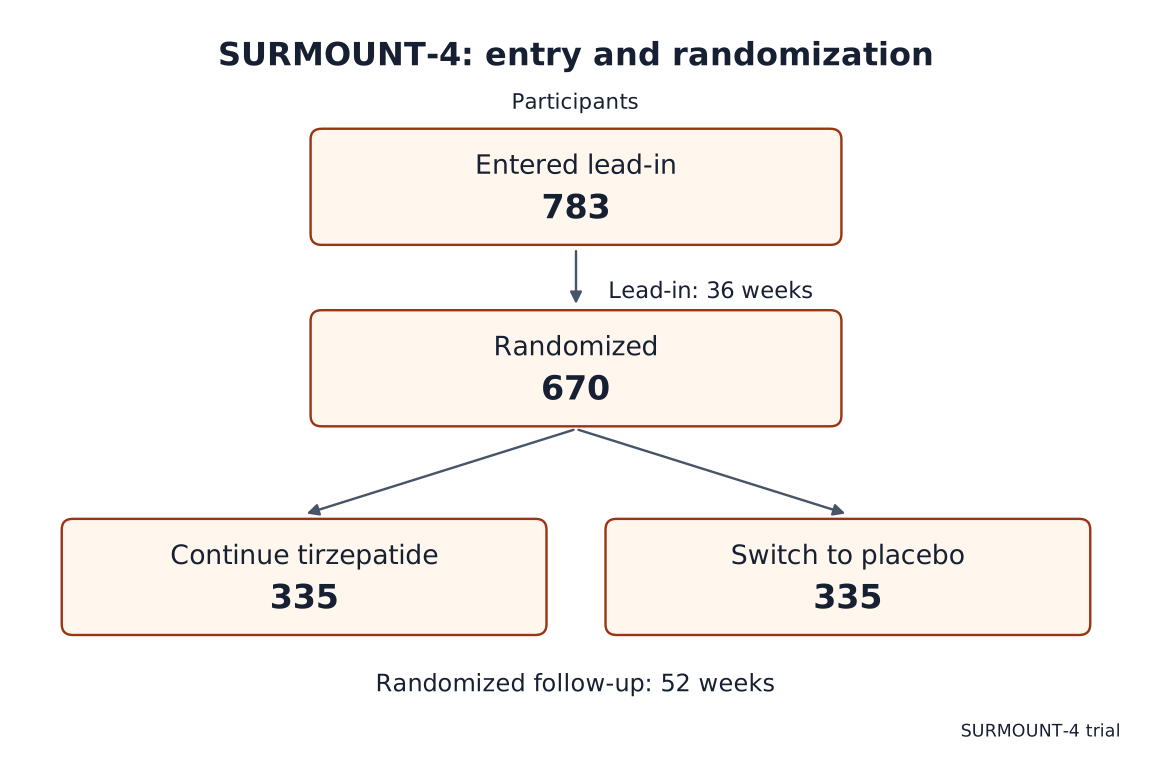
SURMOUNT-4 excluded diabetes. Eligibility for randomization followed exposure to tirzepatide. Lilly funded the trial. [3]
Read the accompanying flow diagram from its entry point toward its fork. The fork identifies the comparison, while the preceding path defines the population available for that comparison. A question about what happens after the fork therefore has a different starting point from a question asked at initial entry. The diagram helps make that distinction visible without explaining every experience along the earlier path.
Selection before assignment and imbalance between assigned groups are different problems. The first concerns which people the comparison can represent. The second concerns whether the groups being compared differ in ways relevant to its outcome. A selected population can still support a valid randomized comparison within its boundaries. Conversely, a diagram with neatly divided branches cannot by itself show that every characteristic was identical across those branches or that all later measurements were available.
The space between entry and assignment is not a diagnosis. A flow count records membership at a stage; it does not attach a reason to every person outside the next stage. Reading it as a tally of intolerance would replace a documented count with an unsupported explanation. It would also mistake a population description for an outcome comparison. The figure is most useful as a guide to where the randomized question begins, not as a verdict on what happened to everyone who entered.
SURMOUNT-4: entry and randomization
On a narrow screen, scroll the chart and data table horizontally. You can also download both files.
Download chart (SVG)Download chart data (CSV)
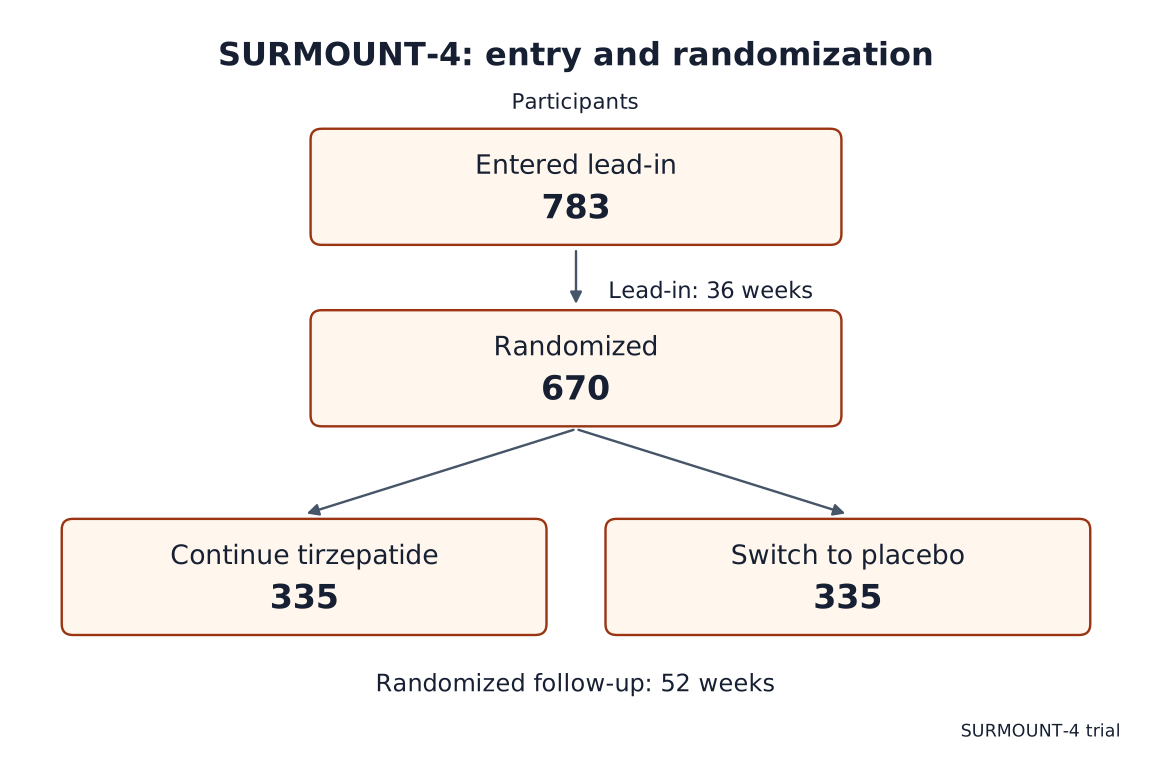
| Stage | Participants |
|---|---|
| Entered lead-in | 783 |
| Randomized | 670 |
| Continue tirzepatide | 335 |
| Switch to placebo | 335 |
The randomized question remains conditional
A response condition and a prior-exposure condition restrict a question in different ways. One asks the reader to carry forward an already observed response; the other asks the reader to carry forward a treatment history. Neither can be replaced by the vague phrase “people interested in treatment.” That phrase would erase the very condition that defines whom the subsequent comparison describes. The distinction matters even when the same outcome is eventually measured.
There are two separate standards here. A comparison should be credible for the population that generated it, and its relevance to another population should be justified. Strong evidence for the first does not automatically settle the second. This is why describing a trial as selected is not equivalent to dismissing it. Selection may make the question more specific and useful, provided the answer retains that specificity when it leaves the research report.
Extending an answer requires more than noticing that another group uses the same medicine. One would need a defensible account of which differences between the groups could matter and evidence that supports the extension. Without that account, assuming identical results and assuming worse results are both premature. The tirzepatide evidence profile provides a separate place to orient product questions; a profile label cannot substitute for examining the population behind an individual result.
Symptoms change the grouping after randomization
The symptom definition in the opening section turns an experience into a category. Such a category is useful for sorting observations, but its boundaries are not a complete description of lived burden. Frequency, intensity, duration and disruption are separate dimensions. A yes-or-no classification does not become a measurement of all those dimensions merely because its name refers to a symptom. Interpreting it accurately begins with keeping the category and the broader experience separate.
There is a second distinction between receiving an assigned treatment and belonging to a later symptom group. Random assignment creates a comparison between treatment alternatives. It does not make every later characteristic randomly distributed. Consequently, comparing outcome measurements across symptom categories does not isolate what producing the symptom would do. The category may organize a useful description while leaving the explanation for the observed relationship unresolved.
The category boundary also determines what its opposite means. Outside a defined group does not necessarily mean outside every related experience. A negative classification answers the membership question encoded by that definition, rather than every question a reader might associate with the label. This matters when a broad word such as “tolerability” enters the discussion: that word can imply a much richer account than the sorting rule supplies. The strength of the finding depends on respecting that narrower meaning, not on stretching it to cover more experiences.
Which measurements survive the analysis rule?
The ICH framework asks investigators to specify the population, outcome and handling of events such as stopping treatment. Different choices can answer different treatment questions. [4]
The measurement rules stated earlier are part of the question, not merely technical cleanup. A weight measurement has a time and a treatment context. Changing which contexts are eligible can change the meaning of the summary even if the outcome remains weight. The additional rule in the diabetes comparison should therefore stay attached to that comparison; applying a single broad description to every analysis would conceal a relevant boundary.
An observation that is unavailable and an observation that is outside an analysis by definition are conceptually different. The first raises a question about what was not observed. The second raises a question about what the chosen analysis includes. A record can also contain some usable observations without supplying every desired later measurement. For that reason, a statement about excluded measurements cannot be translated into a blanket statement that particular people disappeared from all research follow-up.
To study a broader treatment course, an investigator would need to specify what should count after circumstances change and how incomplete records would be handled. Simply adding a later value to a table would not resolve those choices. Nor can the direction of a resulting difference be deduced from the exclusion rule alone. That would require information about the observations and the people contributing them. Here the defensible conclusion concerns the scope of the answer, not an invented correction to its size.
A study endpoint is also an exposure history
An endpoint is a position on a timeline, and a timeline has an origin. Two measurements described as final may follow different kinds of preparation or exposure. The word “final” tells us where a measurement sits within its own sequence; it does not tell us that the sequences are interchangeable. Reading the endpoint alongside the entry conditions prevents a calendar label from doing more scientific work than it can support.
The distinction between an earlier response and an earlier treatment history is especially relevant when the later question concerns symptoms. A measurement taken after assignment does not erase the path to assignment. Yet the existence of that path does not reveal when a particular event occurred, how long it lasted or why someone did not reach a later stage. Those are separate observations that would have to be documented rather than reconstructed from a recruitment diagram.
Comparable-looking outcome labels can therefore conceal different questions about time. A fair interpretation preserves what preceded the comparison instead of treating all endpoints as one common observation window. Readers using the semaglutide and tirzepatide comparison guide should keep that distinction in mind: placing medicines beside each other helps organize questions, but it cannot create a shared trial timeline or turn separate symptom analyses into a direct comparison.
Association, mediation and transport ask different questions
Association asks whether measurements vary together. A causal pathway asks how an effect might operate. Applying a result to a different population asks whether the relevant relationships would carry over. These questions are connected, but an answer to one does not automatically answer the others. In particular, a symptom association cannot by itself show what would happen if someone deliberately caused or prevented that symptom.
A pathway model would need assumptions about the relationships it seeks to separate. Its interpretation would depend on whether the measured variables and their ordering adequately represent those relationships. A numerical decomposition does not remove that dependence. Nor does it turn an observed symptom category into an assigned intervention. This is the crucial distinction between describing a possible route through the data and establishing a practical way to reproduce an outcome.
Even a convincing explanation within a studied population would leave the applicability question open. The entry conditions discussed here identify the people for whom that explanation would first need to hold. Extending it would require an additional argument, not merely more confidence in the original model. The broader peptide evidence library can help readers find related topics, but neighboring entries should not be treated as evidence that different treatments or populations share an identical causal pathway.
What evidence would close the remaining gaps?
Different gaps call for different research. A question about people before an eligibility threshold would require a design that follows that broader population and states how the later selection is handled. A question about outcomes after treatment changes would require suitable observations and an explicit analysis plan for those circumstances. Neither question is answered merely by enlarging a dataset that retains the same boundaries.
A fuller account of symptom burden would require measurements designed to distinguish the experiences that a broad category combines. Frequency, intensity and disruption could be specified as separate questions, with consistent definitions and a clear observation window. These are proposals for what evidence would be informative, not claims that an unreported dataset exists. Their value is that they identify what would need to be measured before a broader conclusion becomes supportable.
The funding disclosures also belong in the assessment, but they cannot replace it. Sponsorship gives a reader a reason to examine decisions about design, analysis and reporting; it does not establish the direction of a result by itself. Commercial evaluation requires its own documentation. Readers considering a service can examine the dated information in our Hims review, while keeping provider claims separate from the treatment and population questions these trials investigate.
Bring the finding back to a clinical question
Zepbound can cause severe gastrointestinal reactions and is not recommended with severe gastroparesis. Severe or persistent symptoms need clinical assessment; symptoms do not establish treatment success. [5]
A clinical conversation should distinguish an individual concern from the group relationship discussed in a research paper. The article cannot determine whether someone should continue, stop or change treatment. A symptom category does not contain the full information needed for that decision, and an explanation of an association is not a personal treatment plan.
Compounded versions are not FDA-approved. [6]
The guide to brand-name and compounded products addresses a separate product question. Keeping that question distinct prevents a trial discussion from becoming an implied endorsement of every product described with a similar name. Evidence interpretation, current safety information and product identification have different roles; none can stand in for the others when a reader brings a concern to a clinician.
Questions about the evidence
Was everyone entering the study randomized?
No. Read the diagram as a sequence rather than several labels for an identical group. The population at the assignment point defines the randomized comparison; an earlier enrollment total does not enlarge it. The earlier stage remains relevant to understanding who reached that comparison. It does not supply a treatment contrast for everyone outside it or establish why any particular person did not proceed.
Does a nausea group represent all digestive symptoms?
No. A label tells you how observations were sorted under a definition. It does not automatically describe every related experience or its burden. To interpret a group as a complete tolerability profile, the evidence would need to support that broader meaning. Ask what the category captures and what additional measurements a broader description would require, rather than reading a comprehensive clinical story into the name.
Can the trial tell what happens after treatment stops?
The relevant distinction is between this analysis and every question that could be asked of a trial. Its stated measurement rule defines the answer available here. It does not establish that all other observations were absent. A question about a later treatment course would need an analysis explicitly designed for that course, including a clear account of available measurements and how gaps were handled.
Editorial assessment
The most useful reading of the symptom comparisons starts with membership. First identify the population for whom assignment occurs, then ask how later groups and eligible measurements define the analysis. Those stages can narrow the answer in different ways. A restriction before assignment concerns whom the randomized comparison represents; a grouping afterward raises a different question about what can explain an observed association. Neither distinction supplies a reason to dismiss the evidence. Together they provide a way to use it precisely. The result should retain the boundaries that make it interpretable when it is discussed outside the report. A broader claim about new patients, complete tolerability or an individual treatment decision needs additional support appropriate to that claim. The scientific contribution is a better specified question and a clearer account of whose observations answer it, rather than a universal promise extracted from a symptom label.
Source documents
- SURMOUNT GI analysis · Checked
- SURMOUNT-3 trial · Checked
- SURMOUNT-4 trial · Checked
- ICH E9(R1) · Checked
- Zepbound label · Checked
- FDA compounding · Checked